

1. Purpose of the Terms and Conditions Analysis
The T&C Analysis is the nextAI functionality within Contract Management that automatically compares an uploaded contract document with the internally established company terms. For each term, it is indicated whether the clause is present in the document, matches the standard, or deviates from it.
The functionality consists of two parts:
- Management – recording the company terms, term types, document types, and exceptions in Admin.
- Analysis – performing a comparison based on an uploaded contract document and viewing the results.
2. Access and Permissions
The Terms Analysis button in the contract overview is only visible and accessible to users with the role of Contract Management Moderator or Contract Manager.
Management of terms in Admin is reserved for administrators with access to the Admin environment.
3. Managing Terms in Admin
Before a Terms Analysis can be performed, the company terms must be recorded in Admin. This is a one-time setup and can be expanded or adjusted as needed afterwards.
3.1 Navigation
Go to:
Admin > Contracts Settings > Tables > Terms and Conditions Analysis
Four subtabs are available here:
- Terms and Conditions – the company terms to be compared
- Exceptions – exceptions to terms for specific categories or suppliers
- Term Types – categorisation of terms
- Document Types – types of contract documents (e.g. NDA, DPA, Master Agreement)
3.2 Managing Document Types
Document types are used to link terms to specific types of contract documents.
During an analysis, filtering by document type is possible so that only the relevant terms are included.
Go to the Document Types tab and click Add to add a new document type.
Enter the name and click Add to save.
3.3 Managing Term Types
Term types are categories created by the administrator to group terms, such as "Financial", "Compliance", or "Risk".
Go to the Terms and condition Types tab and click Add to add a new type. Enter the name and click Add to save.
3.4 Adding a Term
Go to the Terms and Conditions tab and click Add. The form "Add a Term" opens with the following fields:
- Name - the name of the term.
- Description - a description of what the term entails and what nextAI should look for in the document. Maximum 255 characters.
- Numeric Value - a numeric standard against which the found value is assessed, if applicable (e.g. a number of days or an amount).
- Preferred Way - the desired comparison direction. Options include:
- Not Relevant - the term is ignored in the analysis.
- Match - the found value must exactly match the standard.
- More - the found value may be greater than the standard.
- Less - the found value must be less than the standard.
- Document Types - link to one or more document types. Only applicable when an analysis is filtered by that document type.
- Term Type - link to a term type for categorisation.
- Companies - link to one or more internal business entities. Only applicable when an analysis is filtered by that company.
- Categories - link to one or more categories from the standard category structure.
Click Add to save the term.
3.5 Adding an Exception
Exceptions make it possible to set a different standard for an existing term for a specific category or supplier. The term is still included in the analysis but assessed against the different standard.
Go to the Exceptions tab and click Add. The form "Add Exception" opens with the following fields:
- Term/condition - select the existing term to which the exception applies.
- Name - the name of the exception.
- Description - a description of the exception. Maximum 255 characters.
- Numeric Value - the differing numeric standard for this exception.
- Preferred Way - the desired comparison direction for this exception (Not Relevant / Match / More / Less).
- Categories - the category for which the exception applies.
- Supplier - the supplier for which the exception applies.
Click Add to save the exception.
ℹ️
For IT contracts there is an exception where 45 days is also acceptable, with Preferred Method "More". IT contract terms that specify, for example, 50 days are now considered positive; the standard of 60 days does not apply, and the value is more than 45 days.
4. Performing a Terms Analysis
4.1 Navigation
Go to:
Contract Management
The T&C Analysis button is visible in the contract overview, to the left of the New Contract button.
4.2 Steps
1. Start Analysis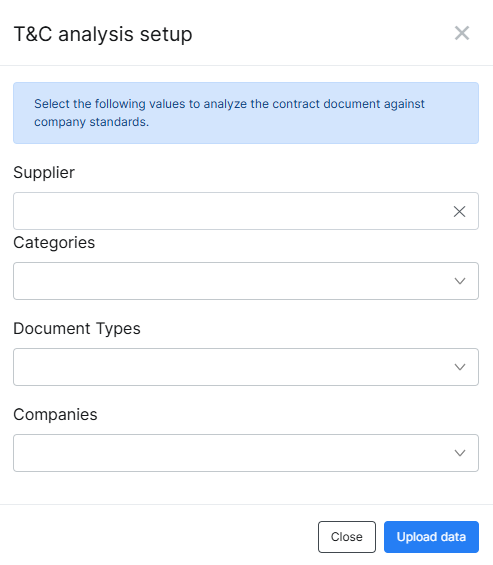
Click T&C Analysis. The window "Terms Analysis Settings" opens with the instruction text: "Select the following values to analyse the contract document based on the company standards."
Set the desired filters. All filters are optional:
- Supplier – limit the analysis to terms and exceptions linked to this supplier.
- Categories – limit the analysis to terms and exceptions linked to these categories.
- Document Types – limit the analysis to terms linked to this document type.
- Companies – limit the analysis to terms linked to this business entity.
If no filter is selected, all active terms are included in the analysis.
2. Upload Document
Click Upload data. Select the contract document to be analysed. nextAI processes the document and compares the content with the selected terms.
3. View Results
After processing, the results page "Terms & Conditions Analysis - Results" is displayed.
5. Interpreting Results
5.1 Filter View
At the top of the results page are four filter buttons showing the total number of findings per category. Click a filter button to view only the results of that category:
- Positive – the found value meets the standard or is more favourable than the standard.
- Negative – the found value does not meet the standard.
- Matching – the found value exactly matches the standard.
- Not Found – the term was not found in the document.
5.2 Result per Term
The following data is shown per term:
- Standard Term – the description of the internally established standard.
- Found in Document – the text that nextAI found in the document for this term.
- Source – the reference to the article or location in the document where the clause was found.
- Status – the judgement at the top right per term (Positive / Negative / Matching / Not Found).
5.3 PDF Viewer
On the left of the results page, the uploaded document can be viewed via the built-in PDF viewer. This makes it possible to view the found clauses directly in context.
6. Best Practices
- Set terms as specifically as possible to obtain accurate results.
- Use Document Types and Companies to focus the analysis on the correct terms.
- Use exceptions for categories or suppliers where different standards apply, instead of creating separate terms.
- Always manually check all results – nextAI supports the assessment but does not replace it.
- Encrypted (password-protected) PDFs and PDFs with an Adobe Acrobat Sign agreement are not supported.
7. Summary
- The T&C Analysis compares an uploaded contract document with internally established company terms.
- Terms, term types, document types, and exceptions are managed via Admin > Contracts Settings > Tables > Terms and Conditions Analysis.
- A Preferred Way is set per term: Not Relevant, Match, Less or More.
- Exceptions make it possible to set different standards for specific categories or suppliers.
- The analysis is started via the T&C Analysis button in the contract overview, available to users with the role Contract Management Moderator or Contract Manager.
- The results page shows the judgement per term (Positive, Negative, Matching or Not Found), the found text and the source reference, with the uploaded document in a built-in PDF viewer.